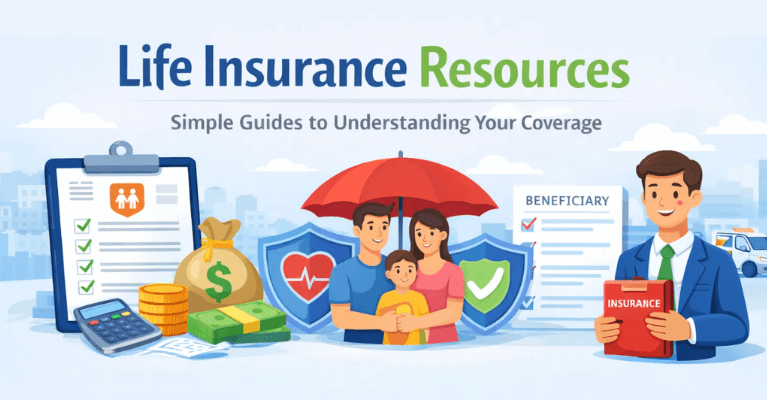
Life insurance is designed to provide financial protection for your loved ones if you pass away. It helps replace lost income, cover debts, and manage final expenses. Understanding how life insurance works begins with learning the basic parts of a insurance policy and the different coverage options available.
This guide explains everything in simple terms.
Life insurance is a contract between you and an insurance company. You agree to pay a regular premium, and in return, the company agrees to pay a lump sum (called a death benefit) to your chosen beneficiaries if you pass away while the policy is active.
The purpose is to protect the people who depend on you financially.
Death Benefit
The amount of money paid to your beneficiaries when you pass away. It is typically income-tax free.
Beneficiaries
The people (or organizations) you choose to receive the death benefit.
Premium
The payment you make monthly or annually to keep the policy active.
Policy Term
The length of time your coverage lasts (for term life policies).
There are two primary life insurance coverage options:
Covers you for a specific period (10, 20, or 30 years)
Usually more affordable
No cash value
Ideal for income replacement during working years
Provides lifetime coverage
Builds cash value over time
Higher premiums
Can be used for long-term financial planning
The amount depends on:
Annual income
Outstanding debts
Mortgage balance
Children’s future expenses
Savings and investments
A common guideline is 10–15 times annual income, but every situation is different.
You need to know about home owners insurance to understand what it covers and how it can help protect your property.
Estimate a coverage amount based on income replacement and common financial goals.
Educational estimate only (not financial advice).
Simple coverage for a set period of time, designed to replace lost income.
Learn how term and whole life insurance differ in cost, coverage length, and benefits.
A simple expense calculator to determining the right life insurance amount for you.
The amount of life insurance you need depends on income, debts, and future financial goals. Many experts suggest 10–15 times your annual income, but your ideal coverage should also consider mortgage balance, children’s education costs, and existing savings.
Term life insurance is typically the most affordable option. Because it provides temporary coverage for a specific period, premiums are usually lower than permanent life insurance policies.
When a term life policy expires, coverage stops unless renewed or converted. Some policies allow renewal at a higher premium, while others offer the option to convert to permanent coverage before the term ends.
For many families, term life insurance is enough. It provides affordable coverage during the years your income is most needed. However, those seeking lifelong coverage or cash value benefits may consider permanent life insurance options.
Yes, some life insurance policies are available for people with health conditions. Options may include simplified issue or guaranteed issue life insurance, though premiums may be higher and coverage amounts lower.