
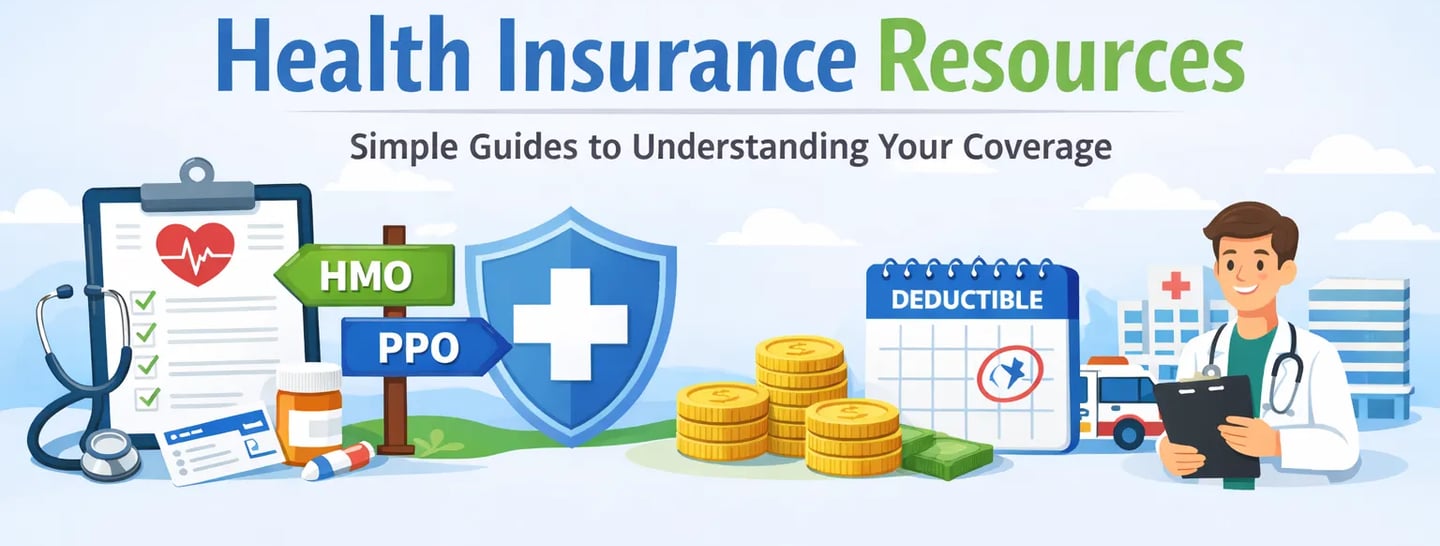
Health Insurance Resources: Simple Guides to Understanding Your Coverage
Health insurance helps pay for medical expenses so you’re not responsible for the full cost of doctor visits, hospital stays, prescriptions, or emergency care. Understanding how health insurance works starts with learning a few key terms and how plans are structured.
What Is Health Insurance?
Health insurance is a contract between you and an insurance company. You pay a monthly fee (called a premium), and in return, the insurance company helps cover certain healthcare costs.
Instead of paying thousands of dollars out of pocket for medical care, your insurance shares those costs with you.
Key Terms You Should Know
Premium
Your premium is the monthly payment you make to keep your coverage active.
Deductible
A deductible is the amount you must pay out of pocket before your insurance starts covering many services.
Copay
A copay is a fixed amount you pay for certain services, such as $25 for a doctor visit.
Coinsurance
Coinsurance is the percentage of costs you pay after meeting your deductible (for example, 20% of a hospital bill).
Out-of-Pocket Maximum
This is the most you’ll pay in a year for covered services. After reaching it, your insurance usually pays 100% of covered costs.
Types of Health Insurance Plans Explained
There are several health insurance coverage options, but the most common are:
HMO (Health Maintenance Organization)
Requires you to use doctors in a network
Usually requires referrals
Lower premiums
Less flexibility
PPO (Preferred Provider Organization)
More flexibility
No referrals needed
Higher premiums
Can see out-of-network providers (at higher cost)
High Deductible Health Plan (HDHP)
Lower monthly premium
Higher deductible
Often paired with a Health Savings Account (HSA)
What Does Health Insurance Typically Cover?
Most standard plans cover:
Preventive care (checkups, vaccines)
Doctor visits
Emergency services
Hospital stays
Prescription medications
Mental health services
Coverage details vary by plan.
How to Choose the Right Plan
When comparing plans, consider:
Your monthly budget
How often you visit doctors
Prescription needs
Family coverage needs
Network restrictions\
A lower premium plan may cost more later if you frequently need care.
When Can You Enroll?
You can usually enroll in health insurance during:
Open Enrollment Period
Special Enrollment Period (after qualifying life events like marriage, job loss, or childbirth)
Missing enrollment deadlines may limit your options.
Final Thoughts
Understanding health insurance doesn’t have to be overwhelming. By learning the basics, premiums, deductibles, coverage types, and cost-sharing, you can make more informed decisions about your healthcare coverage.
The key is not choosing the “cheapest” plan, but the one that fits your healthcare needs and budget.
Health Insurance Cost Estimator
Estimates total annual healthcare expenses by combining premiums, deductibles, and expected medical spending.
Frequently asked questions
What is a deductible in health insurance?
A deductible is the amount you must pay out of pocket before your health insurance begins covering certain medical services. After meeting your deductible, you may still owe copays or coinsurance depending on your plan.
What is the difference between copay and coinsurance?
A copay is a fixed dollar amount you pay for a service, such as $30 for a doctor visit. Coinsurance is a percentage of the total cost you pay after meeting your deductible, such as 20% of a hospital bill.
What is an out-of-pocket maximum?
An out-of-pocket maximum is the most you’ll pay for covered medical services during a plan year. Once you reach that limit, your insurance typically pays 100% of covered costs.
Does health insurance cover preventive care?
Most employer and marketplace plans cover preventive services such as annual checkups, vaccines, and screenings at no additional cost when using in-network providers.
Can I buy health insurance outside of open enrollment?
You can enroll outside of open enrollment if you qualify for a Special Enrollment Period due to events such as marriage, childbirth, job loss, or relocation.
Disclaimer
This website provides general educational information only and is not intended as financial, legal, or insurance advice. Coverage options and regulations vary by state and provider. Always review policy documents carefully and consult a licensed professional regarding your specific situation.
InsuranceSprout © 2026 | Informational resource only
About InsuranceSprout
InsuranceSprout provides independent, educational insurance guides designed to simplify complex coverage topics.